You’ve found a lump. Probably round, smooth, and sitting just beneath the skin. Maybe it’s been there for months. It doesn’t hurt, but it’s growing slowly, or it’s in a place you can’t ignore. If your GP has told you it’s a sebaceous cyst and that it won’t be dealt with on the NHS, you’re not alone. It’s one of the most common reasons people look into private minor surgery in the UK.
Key Takeaways
- A sebaceous cyst is a benign lump under the skin, usually caused by a blocked or damaged hair follicle or sebaceous gland.
- Most cysts are harmless, but they can grow, become infected, or cause discomfort, all of which are reasons to consider removal.
- The NHS rarely funds cyst removal for cosmetic reasons and increasingly limits access even for symptomatic cases.
- Private sebaceous cyst removal is a routine minor surgical procedure, usually done under local anaesthetic with same-day discharge.
- An infected cyst cannot be removed until the infection has cleared. Timing matters.
What Is a Sebaceous Cyst and Is That the Right Name?
The term “sebaceous cyst” is widely used by patients and GPs, but is technically a slight misnomer in many cases. True sebaceous cysts develop from blocked sebaceous glands, the oil-producing glands in your skin, and are filled with a greasy, yellowish substance called sebum. More commonly, what people call a sebaceous cyst is actually an epidermoid cyst, which forms when skin cells multiply inward and create a sac under the skin rather than shedding naturally.¹
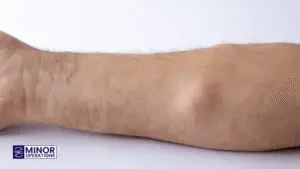
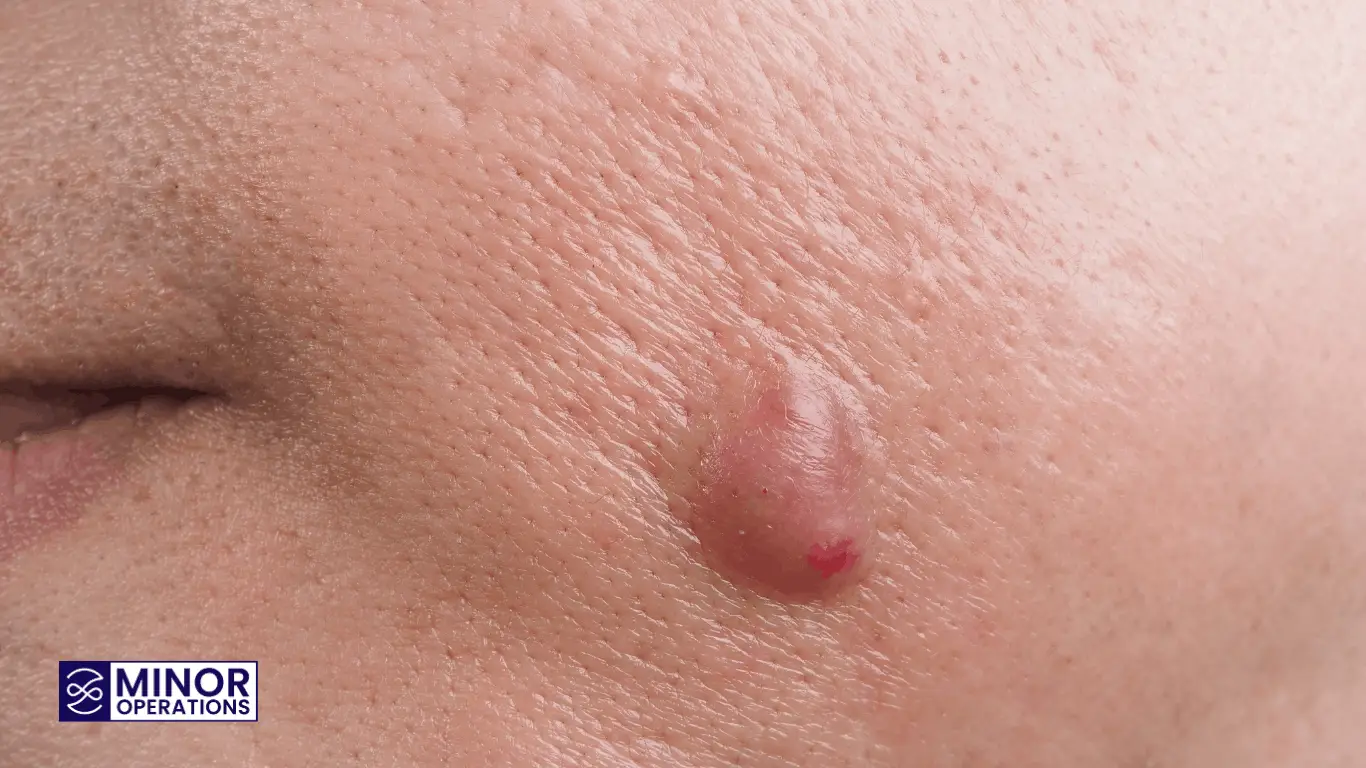
In everyday conversation, the distinction doesn’t matter much. Both types feel broadly similar: a round, mobile lump, often with a small dark dot called a punctum visible on the surface. They grow slowly, tend to appear on the face, neck, scalp, back, and shoulders, and are almost always completely benign. They don’t turn cancerous.
What they do sometimes do, however, is grow. As they grow, they can become more visible, catch on clothing, or, if they become infected, turn red, swell up, and become very painful.
When Should a Sebaceous Cyst Be Removed?
There’s no medical requirement to remove a cyst that isn’t causing problems. Many people live with cysts for years without any issue. But there are good reasons to consider removal before a cyst causes trouble.
Cysts that are growing should be removed while still small. A cyst on the face or neck, removed when modest in size, results in a shorter incision and a far less visible scar than one removed after it has grown considerably.² Equally, a cyst on the body that reaches 2 to 3 cm in size becomes harder to remove cleanly.
If a cyst becomes infected, it fills with bacteria and pus and becomes an abscess. At that point, the immediate treatment is drainage, not full removal. The cyst sac remains, which means it will very likely return. Full surgical removal can only be carried out once the infection has completely settled, usually after two to three months.³ Removing a cyst before it reaches this point is, in the long run, simpler and more effective.
Does the NHS Fund Sebaceous Cyst Removal?
Increasingly, no, at least not for the majority of patients. NHS commissioning policies in most parts of England now classify cyst removal as a procedure of low clinical priority when the cyst is not causing a medically significant problem.⁴ Infected cysts that have developed into abscesses may be drained in a GP or minor surgery setting, but full excision, meaning complete removal of the cyst sac, is rarely funded unless clinical criteria are met.
Patients who visit their GP with a cyst that isn’t infected or causing functional impairment are often told to monitor it and return if it changes. That’s a reasonable position from the NHS perspective, but it can leave people stuck. They’re managing something that is clearly getting worse but unable to access treatment until it becomes a crisis.
Private cyst removal resolves that. It allows you to have the cyst removed at the right time, by experienced clinicians, in a sterile clinical environment, before the situation becomes more complex.
What Does Private Sebaceous Cyst Removal Involve?
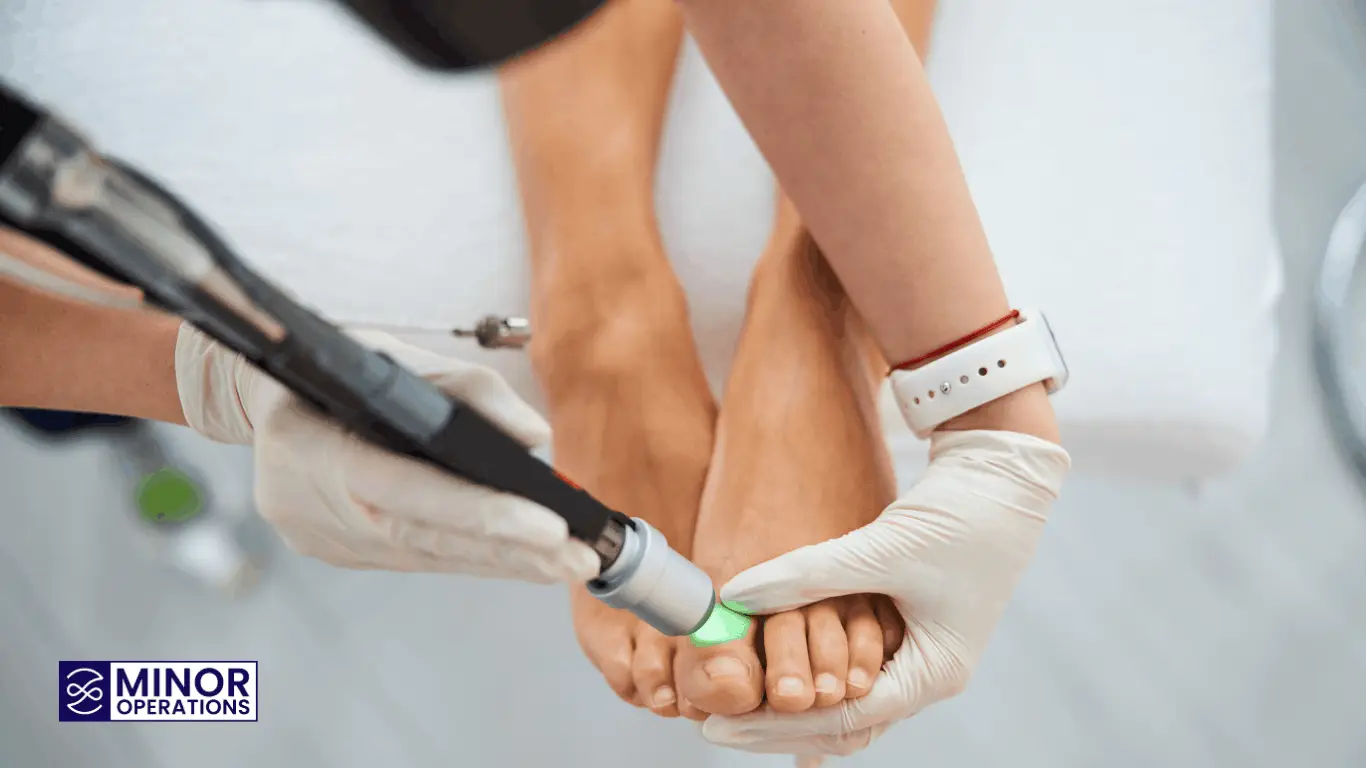
Private cyst removal is a minor surgical procedure performed under local anaesthetic. The clinician marks the area, injects a numbing agent, and makes a small incision. The goal is to remove the entire cyst sac. If any sac lining is left behind, the cyst is likely to return.⁵ The wound is then closed with stitches, which are typically removed after 7 to 14 days.
The procedure usually takes between 20 and 45 minutes. You go home the same day and can return to light activity the following day. There will be a scar, but an experienced clinician will position the incision along natural skin lines to keep it as discreet as possible.
Privately, sebaceous cyst removal in the UK typically costs between £250 and £700, depending on the size, location, and complexity of the cyst. You can find out more and start an enquiry for private cyst removal at Minor Operations.
This article is for informational purposes only and does not constitute medical advice. If you are unsure whether a skin growth is a simple skin tag or something that requires further investigation, please speak to your GP. To find out about accessing private skin tag removal through Minor Operations, visit minoroperations.co.uk.
Frequently Asked Questions
How do I know if my lump is a cyst or something else?
Cysts typically feel round, smooth, and mobile under the skin. They often have a small dark dot on the surface and may discharge a thick, sometimes foul-smelling material if squeezed. Lipomas, another common benign lump, feel softer and sit slightly deeper. Your GP can usually confirm the diagnosis by examination, though some lumps may require ultrasound imaging.
Can a sebaceous cyst go away on its own?
Occasionally, very small cysts resolve without treatment. More commonly, they either remain stable or grow slowly over time. They do not disappear as a result of squeezing. Squeezing a cyst can introduce infection and make things considerably worse.
What happens if I leave a cyst untreated?
Many people live with cysts indefinitely without any problem. The main risk of leaving them is that they may grow over time, become infected, or rupture under the skin, causing an inflammatory reaction. Treating a cyst before these events happen is generally simpler and results in a better cosmetic outcome.
Can a cyst be removed if it’s currently infected?
No. An infected cyst presents as a painful, swollen abscess and requires drainage first. Once the infection has fully cleared, usually after two to three months, the cyst sac can then be surgically removed. Attempting removal during an active infection is not safe and increases the risk of scarring and recurrence.
Is sebaceous cyst removal painful?
The procedure is performed under local anaesthetic, so you should feel little to no pain during it. The numbing injection may sting briefly. After the anaesthetic wears off, the area will feel sore and tender for several days, which is normal and usually manageable with over-the-counter pain relief.
Will the cyst come back after removal?
If the entire cyst sac is removed, recurrence is unlikely. If any part of the sac lining is left behind, as can happen with drainage-only procedures or incomplete excision, the cyst may return. This is why full surgical excision by an experienced clinician gives the best long-term outcome.
Does private cyst removal include histology?
Many private clinics send the removed cyst for histological analysis, examination under a microscope to confirm the nature of the tissue. This is good practice. Always ask whether histology is included in the quoted price before you book.
References
[1] Cosmedics Skin Clinics. (2026) Private cyst removal: types, diagnosis and treatment. Available at: https://www.cosmedics.co.uk/skin-treatments/cyst-removal/private/ [Accessed: 23 April 2026].
[2] Cosmedics Skin Clinics. (2026) When is the right time to remove a cyst? Available at: https://www.cosmedics.co.uk [Accessed: 23 April 2026].
[3] Choice Aesthetics. (2025) Cyst removal London, Surrey and Kent. Available at: https://www.choiceaesthetics.uk/news/cyst-removal-london-surrey-and-kent [Accessed: 23 April 2026].
[4] Coventry and Rugby GP Gateway / NHS. (2025) Removal of benign skin lesions: sebaceous cyst policy. Available at: https://www.coventryrugbygpgateway.nhs.uk [Accessed: 23 April 2026].
[5] Sherif Wilson Plastic Surgeon. (2025) Do I need to see a specialist for cyst removal? Available at: https://www.sherifwilsonplasticsurgeon.co.uk [Accessed: 23 April 2026].